Look up! Orionid meteor shower peaks this week
This meteor shower is called the Orionids, because the radiant point of the shower is near the constellation Orion.
More Stories



One of the most beautiful meteor showers of the year will grace the skies later this week - the Orionids.
This meteor shower is called the Orionids, because the radiant point of the shower is near the constellation Orion.
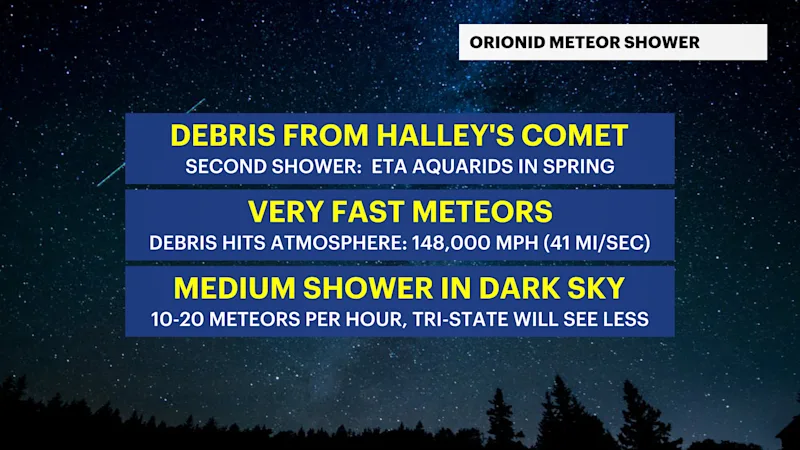
They are created when Earth travels through debris left behind by Halley’s Comet. The peak will occur on the mornings of Oct. 20 to Oct. 22.
Halley’s Comet is a very well-known comet, discovered by Edmond Halley, an English astronomer in 1758. It has a long history, being sighted for millennia.
The last time the comet visited our solar system was back in 1986. The next visit won’t be until 2061, but there is still plenty of debris left behind to create plenty of “shooting stars”.
This will actually be the second meteor shower this year produced by the comet. The first one was the Eta Aquarids in the spring.
The Orionids are known for very speedy meteors that travel at 148,000 mph (or 41 miles per second). This is almost as fast as the Leonids, which occur in November and are some of the fastest showers.
If conditions are just right, where the sky is very dark and free from light pollution, the average amount of meteors one could see would be 10 to 20 per hour.
The maximum one might see near the tri-state area is up to 20. That’s often hard to do in a lot of the tri-state area, but not impossible in the more remote locations.
The weather this year looks ideal for the peak, but the waxing gibbous moon will not be. The moon may drown out the fainter meteors and really reduce the amount one is able to see.
When going out to look for meteors, be sure to look in the opposite direction of the moon. It won’t be setting until after midnight, when the showers should be visible.
Remember that you don’t have to look directly at Orion to see the meteors. They can appear almost anywhere in the sky.
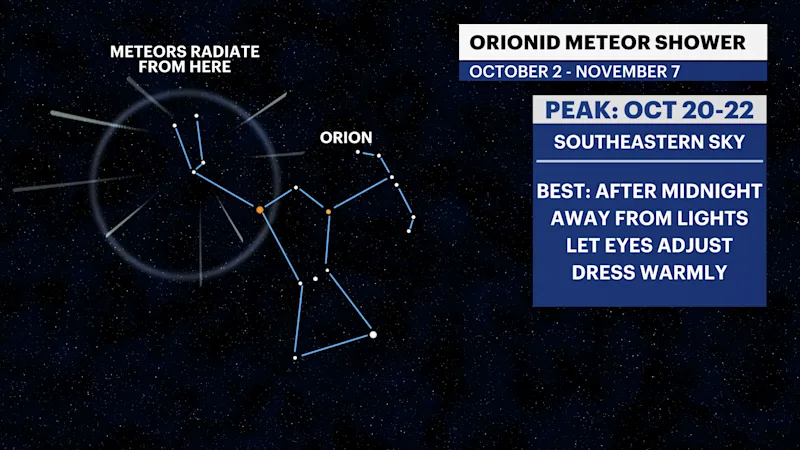
NASA recommends trying to look about 45 to 90 degrees away from the radiant point constellation for best viewing. The streaks they leave behind will appear longer.
Since Orion is a winter constellation, that means this time of year it won’t be high in the sky until late at night.
Best viewing will be overnight with this shower.


