Venus, Jupiter, Mercury and crescent moon visible in next week’s night sky
Mercury will also become more prominent, as it will be farthest from the setting sun on June 15.
More Stories


If you loved last week’s planetary sky dance, you’ll love the coming week as well. Jupiter and Venus are staples in our western evening sky, but starting Tuesday, June 16, a very thin crescent moon returns and joins the group. Mercury will also become more prominent, as it will be farthest from the setting sun on June 15. This is known as greatest elongation.
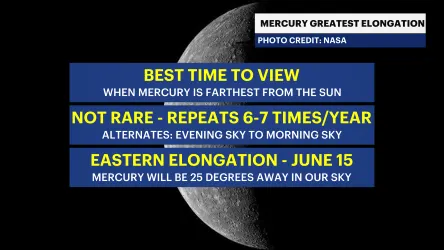
Mercury is an elusive planet that is difficult to view because of its proximity to the sun. It becomes easier to see when at elongation, which occurs several times a year. The planet alternates between the evening and morning sky. Because it follows the sun so closely, it is never far above the horizon. This week, Mercury will be 25 degrees from the sun in our sky.
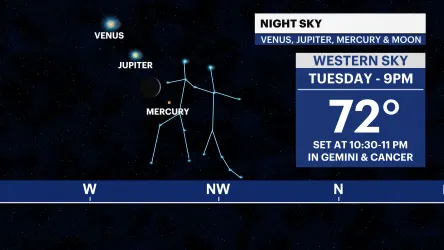
The same planets will be visible again on Wednesday night, but the moon will be slightly higher in the sky and will pair with Venus.
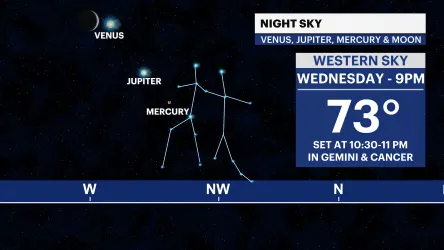
The best time to view these planets will be right after sunset, once the sky becomes dark enough. They will be clustered in the constellations Gemini and Cancer. Mercury will set the earliest, at about 10:15 p.m., so be sure to head out early and find a spot with a wide, open view of the western sky. Mercury will be near magnitude 0, making it visible to the naked eye, but it often gets lost in the glow of sunset and in light-polluted skies in the tri-state area.