Supreme Court says states can ban transgender athletes. What’s the impact in CT?
Tuesday's ruling has no immediate impact on Connecticut, where students can compete under their chosen gender identity. But one group attempting to overturn the policy said, "You're next."
More Stories


States can ban transgender athletes from girls’ sports following a landmark Supreme Court ruling on Tuesday.
The decision has no immediate impact on Connecticut, where students can compete under their chosen gender, but more legal challenges lie ahead.
SUPREME COURT RULING
More than two dozen states ban female transgender athletes.
On Tuesday, the court’s conservative majority ruled that bans in Idaho and West Virginia don’t violate the Constitution. The court said that barring transgender girls and women also doesn’t run afoul of Title IX, the federal law prohibiting sex discrimination in education.
“States may maintain women’s and girls’ sports for biological females” to address safety and competitive fairness concerns, wrote Justice Brett Kavanaugh. “The Constitution and Title IX do not require an overhaul of women’s and girls’ sports throughout America.”
Justice Sonia Sotomayor dissented.
“With the science still evolving, transgender students shouldn’t automatically be shut out of team sports,” she said. “We just simply do not know scientifically that transgender students pose dangers.”
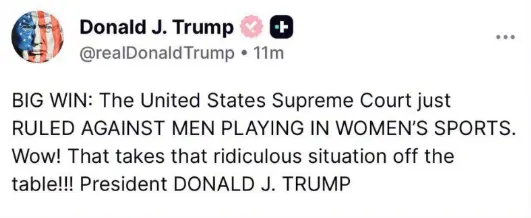
President Donald Trump, who attempted to order a national ban on trans athletes, called Tuesday’s ruling a "BIG WIN" on social media.
“NO IMPACT TO CONNECTICUT”
Despite Tuesday's ruling, nothing will change in Connecticut.
“It’s important for Connecticut residents to know that the state is not required to discriminate against transgender athletes, no matter that the door has been opened,” said Matt Blinstrubas, executive director of Equality Connecticut.
The Connecticut Interscholastic Athletic Conference lets students compete under their chosen gender because state law lists “gender identity or expression” as a protected class.
“This speaks to what other states are doing,” said Attorney General William Tong. “They can [ban transgender athletes] – not, ‘They must.’ So it says nothing about Connecticut.”
New York has a similar law.
“We have laws on the books in the state of New York against discrimination, and we oppose discrimination of individuals based on their gender and their identity,” said New York Attorney General Letitia James, appearing at a conference in Greenwich.
“YOU’RE NEXT”
Opponents are promising to bring Connecticut to the Supreme Court next.
“Blue states with boys on girls’ podiums … you’re next,” Kristen Waggoner, president of the Alliance Defending Freedom, posted on X.
Waggoner’s group is suing to overturn Connecticut’s transgender policy. The Alliance Defending Freedom represents four former athletes, including Alanna Smith of Danbury.
“It’s unfair and it doesn’t allow for a level playing field,” Smith told News 12 Connecticut in 2022.
The U.S. Justice Department is also suing Maine, Minnesota and California – all of which have similar laws. The Trump administration has launched investigations into dozens of other states.
State Rep. Tom O’Dea (R-New Canaan) thinks that Tuesday’s ruling opens the door for Connecticut’s policy to fall.
“It does say that there is a difference between men and women. It is an Equal Protection argument,” he said. “Hopefully the case will move forward.”
Democratic leaders pledged to defend Connecticut’s policy.
“I can’t deal with hypotheticals and what some right-wing zealot will try to do and bring some lawsuit in Connecticut,” Tong said. “I guess we’ll cross that bridge when we get to it.”
Polls show a growing number of Americans think athletes should compete against their birth sex.
In 2025, Pew Research Center found support at 66%, while a New York Times/Ipsos poll found 80% support – including two-thirds of Democrats.
But Gov. Ned Lamont, who is running for a third term, said Connecticut will not abandon transgender youth.
“Transgender young people deserve to participate, compete and belong,” Lamont posted on X. “Here in Connecticut, we love you, we want you here, and we’ll keep standing up for you.”